Mission Archive / Signal Log
The Black Knight Satellite: Is It Real? What the Evidence Actually Shows
Type "the Black Knight satellite" into a search bar and you will fall into one of the oldest rabbit holes on the internet. Grainy photographs. Claims of a thirteen thousand year old alien probe. A tangle of Tesla, Cold War radar operators, and a Space Shuttle crew who supposedly caught it on camera. Somewhere in that pile of half remembered facts and full blown speculation sits a real question worth answering properly: is there actually something up there, or is this one of the most successful myths in modern history?
The short answer is that we know exactly what caused the most famous photographs, and it is not a satellite. The longer answer, the one worth spending a few minutes on, is how a lost piece of spacecraft insulation turned into a legend that has outlived several generations of UFO researchers, space agencies, and skeptics who thought they had put the story to rest for good.
This article walks through the whole timeline: the real radio signals that started it, the astronomer who briefly thought he had cracked an alien message and later took it back, the 1998 photographs that gave the legend its face, and why professional satellite trackers are confident about what they are looking at.
Ask five people what the Black Knight satellite is and you will likely get five different answers, and that is part of the problem. The name gets attached to at least four unrelated events spanning more than a century:
None of these four events were originally connected to each other or to the name "Black Knight." The link was built afterward, by writers and researchers stitching separate mysteries into a single continuous story about one ancient object. Space historian James Oberg, who spent years digging through the archival record, has called it a jumble of independent stories, and that description holds up well once you look at each piece individually.
The Black Knight legend borrows its earliest chapter from a real and well documented event. In 1899, while running high voltage experiments at his laboratory in Colorado Springs, Tesla recorded a set of rhythmic radio signals using his receiving equipment. He described them as too structured to be ordinary static, and he speculated publicly that they might be an attempt at communication from another planet.
Modern researchers generally agree Tesla really did detect something unusual, though not an alien transmission. The leading explanation points to natural radio emissions, most likely from pulsars, a class of rapidly spinning neutron star that emits regular pulses of radio energy at intervals that can sound eerily like a signal. Pulsars were not discovered and named until 1967, nearly seventy years after Tesla's experiments, so there was no framework in 1899 for identifying what he had picked up. His honest confusion, recorded in his own writing, became the founding myth that later writers would build on.
 Nikola Tesla, photographed by Napoleon Sarony around 1898, roughly a year before his Colorado Springs radio experiments. Public domain, published before 1929.
The next thread in the tapestry comes from amateur radio history. During the 1920s, operators experimenting with long wave transmissions noticed something odd: their own signals sometimes returned to them several seconds after transmission, a phenomenon now called long delayed echoes, or LDEs. Scientists in Norway recorded similar echoes in 1928, and the phenomenon has been observed intermittently ever since, though a fully agreed upon explanation still eludes researchers. Proposed causes range from plasma effects in the outer ionosphere to reflections off natural clouds of charged particles trapped near Earth.
In 1973, Scottish engineer Duncan Lunan analyzed a set of these delayed echo recordings and proposed something extraordinary: that the pattern of delays, when plotted correctly, formed a kind of star map pointing toward the constellation Boötes, and that the signals might be coming from an ancient probe parked in orbit around the Moon. It was a genuinely creative piece of analysis, and for a while it captured serious attention within fringe science circles.
Lunan later retracted his own conclusion. He admitted that the star map interpretation depended on choices in his data plotting that were not as objective as he originally presented them, and he described his method in later writing as unscientific. Retractions rarely travel as far as the original claim, though, and Lunan's initial 1973 proposal is still cited today as though it remains an open scientific question. It does not.
Perhaps the strangest thread involves newspaper reports from 1954, three years before Sputnik became the first artificial satellite to reach orbit. Several American papers ran stories claiming the U.S. Air Force was tracking two unidentified objects circling the Earth, phrased in a way that implied artificial satellites already existed before any nation had the rocket technology to put one there.
Researchers who have gone back through the historical record generally interpret these stories as a mix of misreported natural phenomena, possibly small natural objects or optical effects, combined with the sensational reporting style common in that era's press. There is no credible evidence that any government tracked an artificial satellite in 1954, since the engineering required to build and launch one did not yet exist anywhere on Earth. The claim persists mainly because it sounds so specific and official, the kind of detail that feels harder to dismiss than a vague rumor, even though specificity alone does not make something true.
Everything before this point was mostly text and radio data, the kind of evidence that is easy to argue about because there is nothing to look at directly. That changed in December 1998, during Space Shuttle mission STS-88, the flight that carried the first American built module to the newly forming International Space Station.
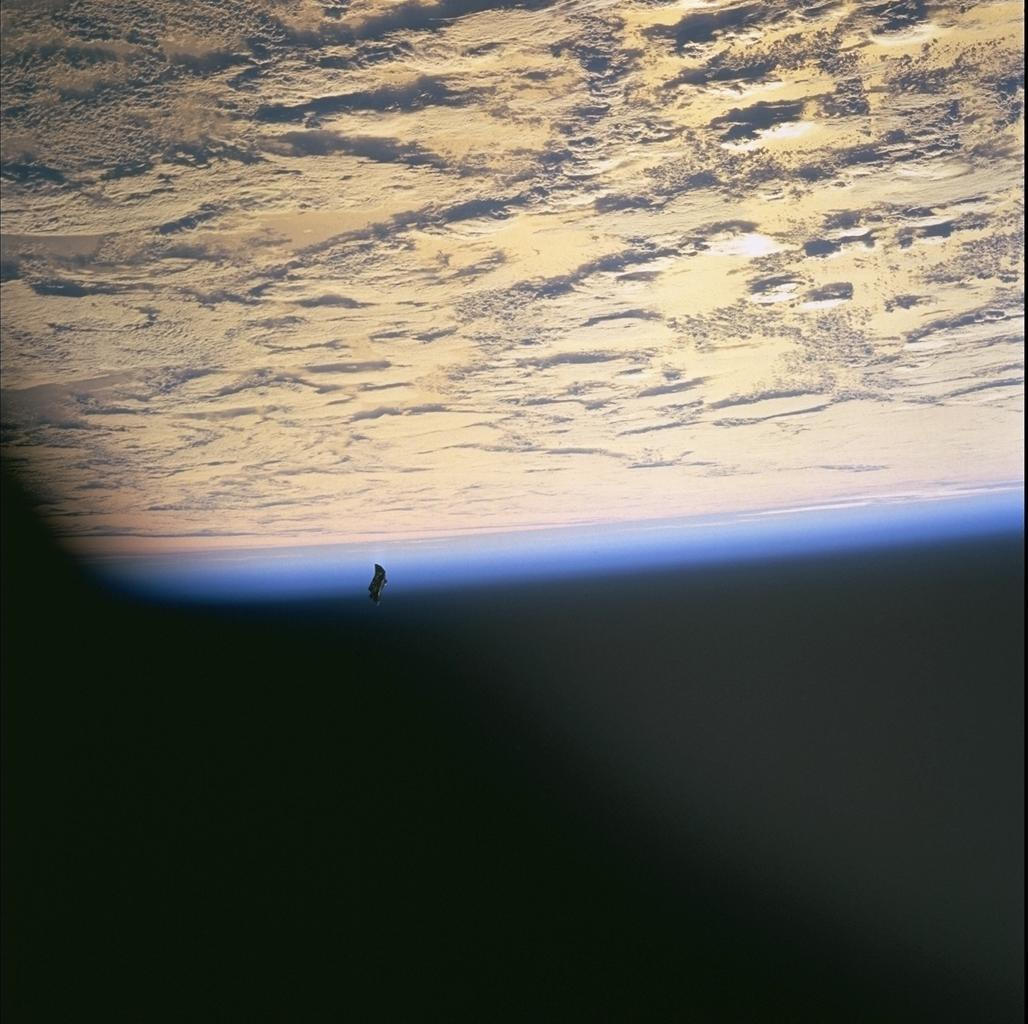
During a spacewalk to attach hardware to the station's Unity module, astronaut Jerry Ross lost hold of a thermal insulation cover. Mission commander Robert Cabana can be heard on the recorded mission audio telling Ross that one of the thermal covers had gotten away from him. The blanket drifted off into orbit, and over the following hours, the crew photographed it repeatedly as it tumbled against the darkness of space and the curve of the Earth below.
The photographs are striking. The object appears dark, irregular, and oddly proportioned, with what look like jagged protrusions along one edge. Photographed against black space with reflected sunlight catching odd angles, a crumpled thermal blanket can look remarkably like a piece of alien hardware, and that is exactly what happened once these images found their way back into public circulation years later.
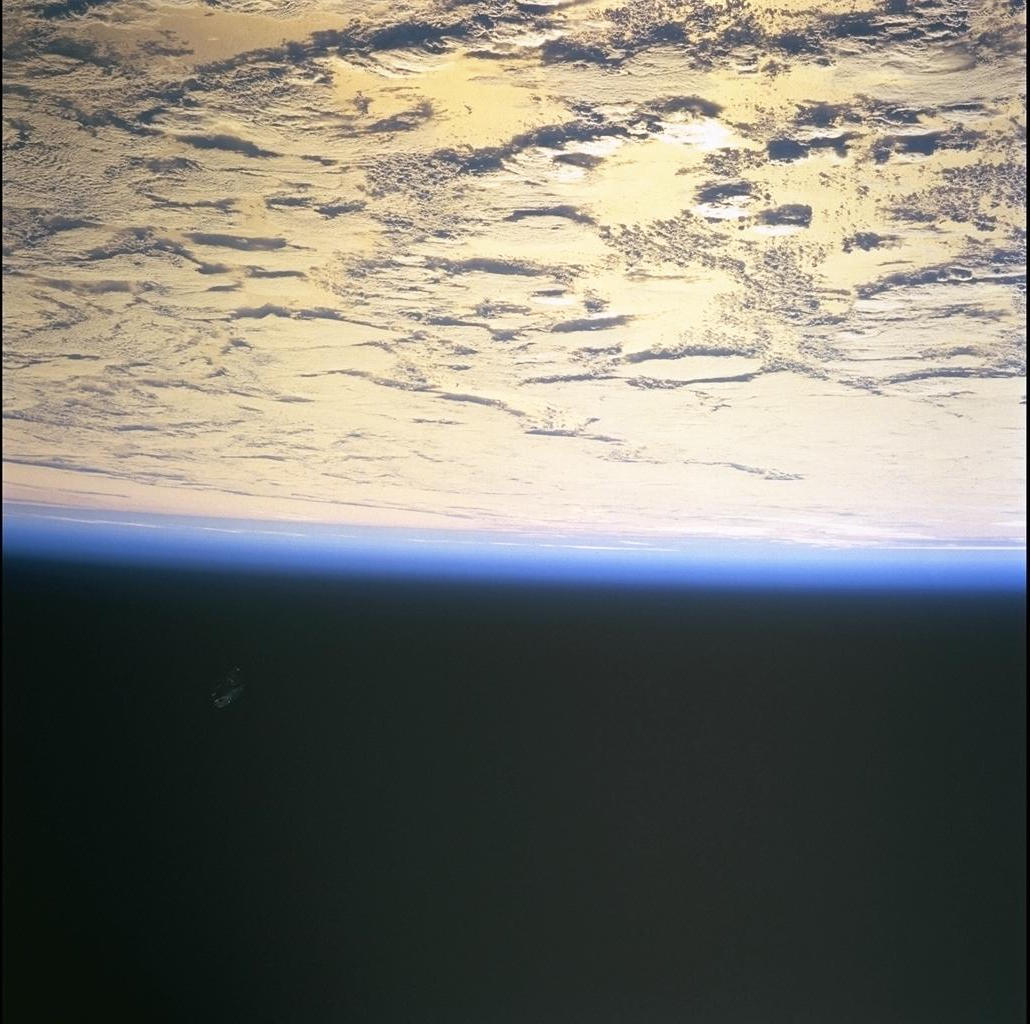 Photographed during STS-88 in December 1998, this frame shows the thermal blanket shortly after it drifted free during a spacewalk. NASA Photo ID STS088-724-65, public domain.A second frame from the same sequence, taken moments later. NASA Photo ID STS088-724-66, public domain.
NASA catalogued the object in its official space debris records under a standard tracking number, the same process used for any sizable piece of hardware lost during a mission. Cosmonaut Sergei Krikalev, who took the original photographs, has confirmed the account, and Jerry Ross himself has spoken about the incident publicly on multiple occasions. James Oberg, who worked on the STS-88 trajectory design team before becoming a space historian, has reviewed the mission footage, transcripts, and photographs in detail and found the thermal blanket explanation consistent at every step, from the radio call announcing the loss to the object's tumbling motion, which matches how a flexible insulation panel behaves in freefall far better than it matches any rigid spacecraft.
It helps to understand just how thoroughly modern space agencies watch the sky above us. The United States Space Surveillance Network tracks tens of thousands of objects in Earth orbit, down to sizes of about ten centimeters, using a global system of radar installations and optical telescopes. Anything large enough to be mistaken for a functioning satellite, let alone one supposedly built by an advanced civilization, would show up clearly and repeatedly in that catalog.
An object claimed to be thirteen thousand years old and still in a stable orbit would also need to defy the basic physics of orbital decay. Low orbits are not permanently stable. Atmospheric drag, however faint at high altitude, gradually pulls objects down over centuries, and anything genuinely ancient would either have reentered long ago or would sit in a very specific, well documented orbit that trackers could verify independently. No such orbit has ever been confirmed. Space debris researchers who study exactly this kind of object, cataloging everything from lost tools to old rocket stages, have never found data supporting an independent, unexplained object matching the Black Knight description.
The tumbling motion visible in the STS-88 photographs also tells its own story to anyone trained in orbital mechanics. A rigid manufactured object, especially one with the kind of angular, technological structure conspiracy theorists describe, tumbles in a fairly regular, predictable way once released into freefall. A loose fabric panel, by contrast, flexes and twists unpredictably as it drifts, exactly the kind of motion visible across the sequence of 1998 photographs.
None of this explanation has stopped the Black Knight from becoming one of the most durable stories in UFO culture, and understanding why is almost as interesting as the physics itself.
Part of it comes down to how our brains process ambiguous images. Humans are extremely good at pattern recognition, a trait that served our ancestors well when spotting predators in tall grass, but the same instinct fires just as strongly when we look at a blurry photograph of tumbling fabric and try to make sense of its shape. Once a pattern like "spacecraft" gets suggested, it becomes difficult to unsee, even after a mundane explanation is presented.
There is also a structural reason the story spreads so well. Each individual piece, Tesla's signals, the 1920s echoes, the 1954 reports, and the 1998 photographs, is documented and real on its own terms. That gives the combined narrative a feeling of accumulated evidence, even though the four events share no verified connection to one another beyond a name applied decades after the fact. A story built from several true but unrelated facts often feels more convincing than a single questionable claim, because each piece seems to corroborate the others when in fact they were never talking about the same thing at all.
Finally, there is a simple appeal to the idea itself. A thirteen thousand year old sentinel quietly watching human civilization develop, waiting for the right moment to reveal itself, taps into something almost mythic, a story with the emotional shape of ancient prophecy dressed in the language of orbital mechanics. Whether or not it holds up as science, it holds up beautifully as folklore, and folklore has never needed to be true to survive.
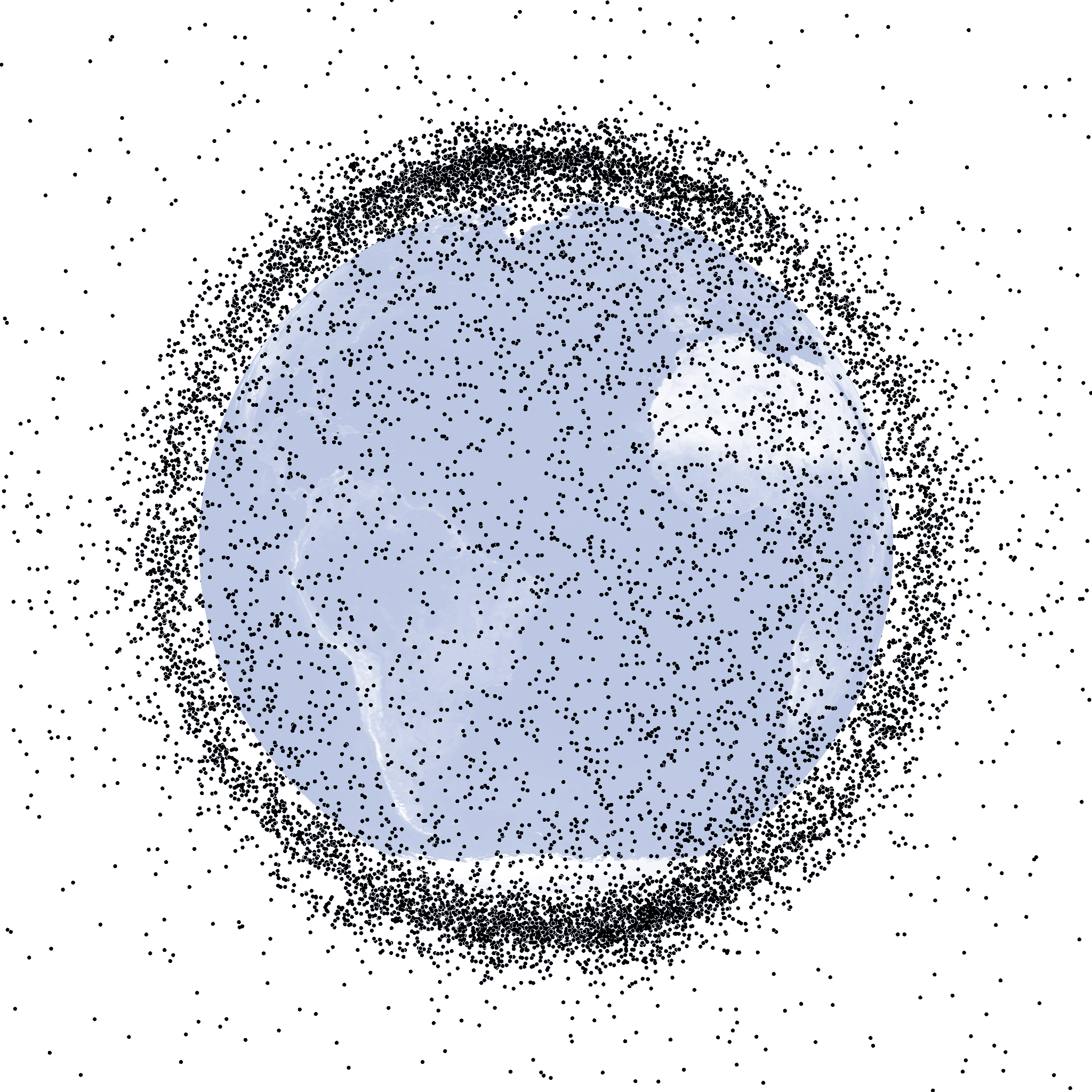 A NASA Earth Observatory illustration modeling the roughly nineteen thousand tracked objects larger than ten centimeters in low Earth orbit. Every one of these objects, real satellites and debris alike, is monitored continuously by ground based radar and optical tracking. Public domain, courtesy NASA Orbital Debris Program Office.
Given how many claims get tangled together under one name, it helps to separate them plainly.
Myth: The Black Knight satellite is a single object with a continuous, documented history stretching back thirteen thousand years.
Fact: The name links four separate, undocumented or misattributed events across more than a century, joined together long after each one occurred.
Myth: NASA photographed an alien spacecraft in 1998 and quietly renamed it space debris to avoid public panic.
Fact: NASA catalogued the object using its standard debris tracking process, the same one applied to every piece of lost hardware, and the astronauts involved have spoken openly about the incident in interviews for decades.
Myth: Duncan Lunan proved the 1920s radio echoes contained a hidden star map from an alien probe.
Fact: Lunan proposed that interpretation in 1973 and later withdrew it himself, citing flaws in his own analytical method.
Myth: Governments were tracking artificial satellites years before Sputnik, proving a cover up predating the Space Age.
Fact: No spacefaring nation had the rocket technology to place an object in orbit before 1957, and the 1954 press reports have never been substantiated by any verifiable tracking data.
The people closest to this story have been remarkably consistent when asked about it directly. James Oberg has stated plainly that every detail of the STS-88 incident, from the radio call reporting the lost blanket to the object's tumbling behavior, lines up with what a lifelong spaceflight operations specialist would expect from a piece of drifting insulation. Alice Gorman, an academic specializing in space archaeology at Flinders University, has likewise supported the debris explanation over any suggestion of an artificial satellite. Martina Redpath, a senior education officer at Armagh Planetarium in Northern Ireland, has described the whole Black Knight narrative as a jumble of completely unrelated stories: genuine scientific puzzles, authors chasing fringe ideas, and ordinary people over interpreting ambiguous photographs.
None of these voices dismiss the individual mysteries as uninteresting. Tesla's signal remains a genuinely curious historical footnote. The long delayed radio echoes of the 1920s still lack a fully settled explanation among atmospheric physicists. What the experts consistently reject is the leap from those unresolved puzzles to a single, continuous, artificial object in orbit.
The Black Knight legend has a habit of going quiet for years and then flooding back into view all at once, and the pattern is almost always the same: someone stumbles across the 1998 photographs without their context, shares them as if newly discovered, and the whole cycle restarts for an audience that has never encountered the explanation.
One of the more unusual revivals happened around 2015, when the photographs resurfaced widely online at almost the same moment that emergency space blankets, the shiny foil sheets used to treat exposure and shock, were appearing constantly in news coverage of the European refugee crisis. The visual similarity between a crumpled gold survival blanket and the object drifting in the STS-88 photographs was not lost on people who noticed both stories trending at once, and the coincidence gave the legend fresh momentum at a moment when the original mission was already seventeen years in the past. It is a small, almost accidental example of how a decades old photograph can find a brand new audience simply by resurfacing at the right cultural moment, stripped of the caption that would have explained it in the first place.
The Black Knight has appeared in film, television, and print for decades. Its most recent appearance is in The Convergence Override by Sainath Mungara, a hard science fiction novel that borrows the name for an entity entirely of its own invention, unconnected to the real STS-88 debris beyond sharing that name. The novel's own Martian setting, including its treatment of the real Black Knight photographs, is covered in the mission archive's survey of Martian geography, and the crew who encounter it have their own personnel files. Readers interested in another famous case of mistaken identity in space may also want our companion piece on the Face on Mars, or our look at whether Jupiter's moon Ganymede could host the next stage of that fictional universe's story.
If the question is whether an ancient, artificial object built by another civilization is currently orbiting Earth, the answer supported by every piece of available evidence is no. The photographs that made the legend famous show a known object, lost during a documented spacewalk, photographed by named astronauts whose account matches the mission's own radio transcripts. The tracking networks that would catch a genuine anomaly have never recorded one. The scientist who provided the legend's most specific claim, the supposed star map hidden in 1920s radio echoes, retracted his own analysis once he examined it more carefully.
If the question is whether something interesting happened, the answer is a clear yes. A real inventor really did puzzle over a real unexplained signal in 1899. Real amateur radio operators really did record a genuinely unresolved atmospheric phenomenon in the 1920s. A real astronomer really did produce a piece of creative, if flawed, analysis in 1973. And a real spacewalk accident in 1998 produced some of the most striking accidental photographs in the history of spaceflight. None of that adds up to a spacecraft, but it adds up to a fascinating case study in how modern mythology gets built, one plausible sounding fact at a time, until the seams between the pieces disappear entirely.
The Black Knight satellite is not up there. The story of how so many people came to believe it was, and why that belief refuses to fade even after every individual claim has been traced back to its mundane source, might be the more interesting mystery after all.
Is the Black Knight satellite real? No credible evidence supports the existence of an artificial, ancient satellite in Earth orbit. The most famous photographic evidence, taken during Space Shuttle mission STS-88 in 1998, shows a lost thermal insulation blanket, confirmed by the astronauts involved and consistent with NASA's own mission records.
What photo is used as evidence for the Black Knight satellite? Two frames photographed during a December 1998 spacewalk on STS-88, catalogued by NASA as photo IDs STS088-724-65 and STS088-724-66, showing a thermal blanket drifting away from the International Space Station's Unity module.
Did Nikola Tesla really detect a signal from space? Tesla recorded an unexplained repeating radio signal in 1899 and speculated it might come from another planet. Most researchers today believe he likely detected a natural radio source, possibly a pulsar, though pulsars would not be identified as a phenomenon for nearly seventy more years.
Where else does the Black Knight satellite appear? Beyond its long life in UFO research and pop culture, it appears as a fictional entity in the science fiction novel The Convergence Override by Sainath Mungara, featured in several scenes of the book.